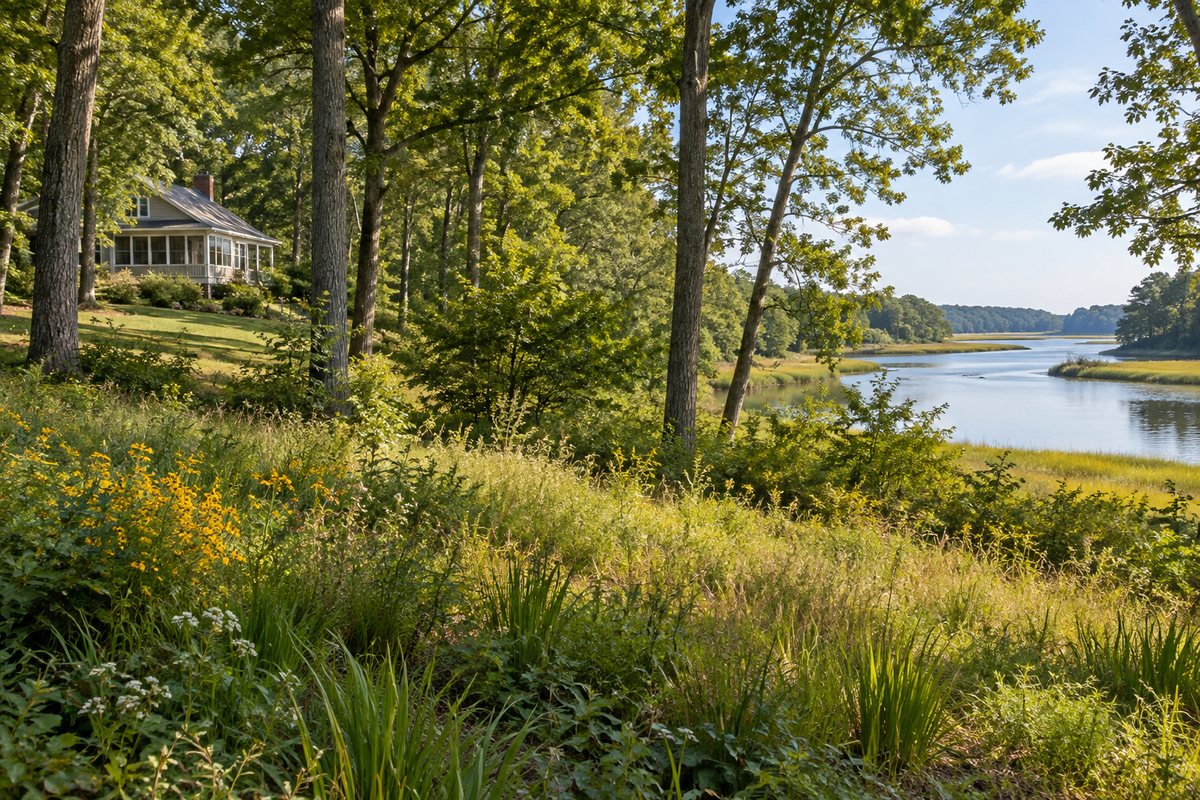

Maryland's Critical Area is all land within 1,000 feet of the state's tidal waters and tidal wetlands, and the first 100 feet of it, the Buffer, is where building and clearing are most restricted. That's according to the Maryland Department of Natural Resources. Most St. Mary's County waterfront homes sit inside it.
If you're buying or selling on the water here, the Critical Area shapes what can be added, cleared or rebuilt on the property. Below I explain the 1,000-foot line, the Buffer, the land designations, lot coverage limits, trees, and how variances work in St. Mary's County. For the rest of the waterfront checklist, see my waterfront buyer's guide.
What Is the Critical Area in Maryland?
It's a protected strip of land along the Chesapeake Bay, the Atlantic Coastal Bays and their tidal tributaries. DNR says the Critical Area "includes all land within 1,000 feet of Maryland's tidal waters and tidal wetlands."
This guide explains the general rules. The mapped designation for a specific parcel, local county review and any exceptions decide what you can actually build, clear or replace, so confirm your property and your plan with the county or town before you rely on it.
For St. Mary's County, with the Potomac River, the Patuxent River, the Chesapeake Bay and many tidal creeks, that's a lot of the waterfront. Being in the Critical Area doesn't stop you from owning or living in a home. It changes the rules for new building, clearing and some repairs.
Most of it is handled locally. DNR says most residential building permits in the Critical Area can be handled by the local government, while variances, special exceptions and disturbances over 5,000 square feet in the RCA get review comments from Critical Area Commission staff.
The Critical Area, From the Water Up
How the rules change as you move inland
- 1Tidal water and tidal wetlands: where the measuring starts.
- 2The Buffer, at least 100 feet: new development and clearing are generally not permitted.
- 3The rest of the Critical Area, out to 1,000 feet: building is allowed, with limits on lot coverage and clearing.
- 4Beyond 1,000 feet: outside the Critical Area, under regular county rules.
Why Does the Critical Area Exist?
To protect the water. The land right next to tidal water filters what runs off into it, and DNR describes the ideal Buffer as planted with trees, shrubs and other plants that catch pollutants coming from "buildings, lawns and paved areas," on its Buffer page.
That purpose explains most of the rules. Keeping the Buffer planted, limiting hard surfaces and replacing trees all slow down runoff before it reaches the creek or the Bay.
How Do I Find Out If a Property Is in the Critical Area?
Ask before you make plans. Outside town limits, St. Mary's County's planning office can tell you whether a parcel is in the Critical Area and which designation applies. Inside Leonardtown, ask the town.
A recent survey or plat for the property often shows the Buffer line, and permits or variance orders from past projects tell you what's already been approved. If you're buying, ask the seller for those documents early in the process.
What Is the 100-Foot Buffer?
It's the land closest to the water, and it's at least 100 feet wide. DNR says "the minimum Buffer width is 100-feet; however, on some properties it may be wider," and on its Buffer page says the Buffer is expanded "in areas where there are adjacent sensitive resources" like steep slopes or soils with development constraints.
Inside the Buffer, DNR says new development that disturbs land or natural vegetation, builds a structure or adds lot coverage is generally not permitted. St. Mary's County's zoning ordinance sets the same minimum 100-foot Buffer in Section 71.8.3, as the county's Board of Appeals noted in a January 2026 case.
That's why the Buffer is the first thing waterfront buyers should ask about. A home that's already there is one thing. An addition, a new deck, a pool or a garage close to the water is another.
What Do IDA, LDA and RCA Mean?
They're the three land designations inside the Critical Area, and they set how much development an area can have. Here's how Maryland's regulations describe them:
| Designation | What it describes | Source |
|---|---|---|
| Intensely Developed Area (IDA) | Areas where residential, commercial, institutional or industrial uses predominate, with features like housing density of at least four units per acre | COMAR 27.01.02.03 |
| Limited Development Area (LDA) | Areas developed in low or moderate intensity uses, such as housing density from one unit per 5 acres up to four per acre, or areas with public water or sewer | COMAR 27.01.02.04 |
| Resource Conservation Area (RCA) | Nature-dominated areas, farms, forest and open space, where new residential development can't exceed one dwelling unit per 20 acres | COMAR 27.01.02.05 |
A single lot can sit in more than one. The January 2026 St. Mary's County Board of Appeals case involved a Piney Point lot partly in the LDA and partly in the RCA overlays. The county's maps show which applies to a parcel.
How Much of My Lot Can Be Covered?
In the LDA and RCA, lot coverage is generally limited to 15% of the lot, under Maryland Natural Resources Article 8-1808.3. Smaller lots that existed before December 1, 1985 have different limits: a lot of one-half acre or less is limited to 25%, and a lot between one-half acre and one acre to 15%.
Before you plan an addition, ask the planning office exactly what counts toward lot coverage on that specific lot. Driveways, sheds and other improvements can all come into play, and the county does the measuring.
The same section lets a local jurisdiction allow those small-lot limits to be exceeded if certain conditions are met, such as keeping coverage to a minimum and providing on-site mitigation or a fee in lieu of mitigation, per 8-1808.3. That's a county decision, case by case.
For buyers, this is the hidden question behind "Can I add a garage?" On a small waterfront lot that's already near its limit, the answer may depend on a variance.
Can I Cut Down Trees in the Critical Area?
Only under the rules. DNR says the Critical Area law "requires no net loss of forest or developed woodland cover," and outside the Buffer replacement planting may be required at a higher ratio than one-to-one, depending on the trees removed.
In the Buffer, DNR says trees can't be removed unless they're dead, dying, diseased or hazardous, and each removed tree under a Simplified Buffer Management Plan is replaced with a 3/4-inch caliper nursery stock tree. Clearing for a better water view is not one of the allowed reasons.
Shoreline work has its own process. My living shorelines guide covers erosion control near the water.
If you inherit or buy a property where a tree in the Buffer looks dangerous, document it and ask the county about the Buffer Management Plan process before anyone cuts. DNR says the plan is submitted to and approved by the local government, usually the planning office.
How Do Variances Work in St. Mary's County?
They go to the county Board of Appeals, and they're not automatic. In the January 2026 case, the board noted that "generally, no new impervious surfaces or development activities may be authorized in the 100-foot buffer" without a variance, and that state law starts from a presumption against granting one.
In that case, the board granted a variance to build a house and driveway on a Piney Point lot, with mitigation planting at a 3:1 ratio and a planting agreement required before a building permit. The order also stated that it wasn't a building permit itself.
Inside the Town of Leonardtown, the town runs its own Critical Area Program, with the Town Administrator reviewing permits and the town's Board of Appeals hearing variances.
Does the Critical Area Affect Septic Systems?
Yes. A new or replacement septic system in the Critical Area must use BAT nitrogen-removal technology under COMAR 26.04.02.07. My guide to septic replacement and BAT in St. Mary's County covers the process and the grant program.
What Should Buyers and Sellers Do About the Critical Area?
Critical Area Checklist
For waterfront buyers and sellers
If you're buying
- Ask whether the home is in the Critical Area and Buffer
- Ask which designation applies: IDA, LDA or RCA
- Ask the county how lot coverage is counted before planning additions
- Check past permits and any variance on the property
If you're selling
- Gather permits, surveys and any variance paperwork
- Know your septic type and its records
- Be ready for questions about piers, trees and additions
- Describe the property accurately; don't promise what can be built
What Does This Look Like for a Real Buyer?
Example scenario: This is a made-up example, not a real client.
Picture a buyer looking at a small waterfront cottage near Piney Point who wants to add a garage and a bigger deck. Before writing an offer, they ask the county whether the lot is in the Buffer and how close it is to its lot coverage limit.
The answer shapes the offer. If the garage would need a variance, the buyer knows it's a maybe, not a plan, and can decide whether they still love the house as it is. That's a far better time to learn it than after closing.
What Mistakes Do Waterfront Owners Make?
- Assuming an existing deck or shed means you can build more. Lot coverage limits apply to the whole lot.
- Clearing for a view. Buffer trees can only be removed for the reasons DNR allows, and replacement planting is required.
- Starting work before asking. Permits and approvals come first.
- Not keeping the paperwork. Surveys, permits and variance orders are what the next buyer will ask for.
Who Should Answer Critical Area Questions?
- St. Mary's County Land Use and Growth Management: designations, Buffer, lot coverage and permits outside town limits.
- Town of Leonardtown: properties inside town limits.
- A licensed surveyor: where the Buffer and property lines actually fall.
- The St. Mary's County Health Department: septic and BAT.
- A Maryland real estate attorney: what a variance or past violation means for a purchase.
The bottom line: on St. Mary's waterfront, ask about the Critical Area before you fall in love with a plan for the property. If you're selling, have your paperwork ready so buyers can see what they're getting. Start with my waterfront guide, or see how I market waterfront homes.
Frequently Asked Questions
It's all land within 1,000 feet of Maryland's tidal waters and tidal wetlands, according to the Maryland Department of Natural Resources. Building, clearing and lot coverage there follow special rules. My waterfront guide covers what else to check.
At least 100 feet from tidal waters, tidal wetlands and tributary streams. DNR says it can be wider on some properties, such as where there are steep slopes or sensitive soils.
In Limited Development and Resource Conservation Areas, lot coverage is generally limited to 15%, under Maryland Natural Resources Article 8-1808.3. Some smaller lots that existed before December 1, 1985 have different limits, including 25% for lots of one-half acre or less.
DNR says trees in the Buffer can't be removed unless they're dead, dying, diseased or hazardous, and under a Simplified Buffer Management Plan each removed tree is replaced with a 3/4-inch caliper nursery stock tree. Check with the county before you cut.
The St. Mary's County Board of Appeals hears variance requests outside town limits, and state law starts from a presumption against granting them. Inside Leonardtown, the town's own Board of Appeals hears them. See my Leonardtown page.
A Critical Area designation for nature-dominated land like farms, forests and wetlands. Under COMAR 27.01.02.05, new residential development there can't exceed one dwelling unit per 20 acres.
Sources: Maryland DNR: Critical Area FAQs · Maryland DNR: Critical Area Buffer · Maryland Code, Natural Resources 8-1808.3 (lot coverage) · COMAR 27.01.02.03 (Intensely Developed Areas) · COMAR 27.01.02.04 (Limited Development Areas) · COMAR 27.01.02.05 (Resource Conservation Areas) · St. Mary's County Board of Appeals, VAAP 25-2136 (hearing January 8, 2026) · Town of Leonardtown Critical Area Program · COMAR 26.04.02.07 (BAT in the Critical Area). Checked October 2026; rules and rates can change, so confirm anything that affects your decision.
This article is general real estate information, not legal, lending, tax, or insurance advice. Talk with the right licensed professional about your specific property.
Buying or Selling on the Water?
Nicole will help you figure out which Critical Area questions apply to a property before you make decisions.
Get My Free Home Valuation Schedule a Consultation